Pula in summer does not slow down when the sun sets. If anything, it gets better. The heat softens, the old town empties slightly, and the city starts to feel like it belongs to the people in it rather than the crowds passing through. Here is how to spend a Pula evening properly.
Start before sunset: La Yugo Vita
La Yugo Vita is best enjoyed after 7pm. That is not a coincidence. When the light changes over the Uljanik cranes and the bay turns gold, Pula looks completely different. Experiencing it from the back seat of a 1979 Stojadin makes it better still. The tour covers the Yugoslav-era history of the city: the shipyard, the workers’ housing in Veruda, the old military zones, Karlo Rojc. Evening timing puts you in the city at its most photogenic and least crowded. La Yugo Vita runs for two hours and tends to set the tone for everything that follows.
Book La Yugo Vita here.
Watch the Uljanik cranes light up
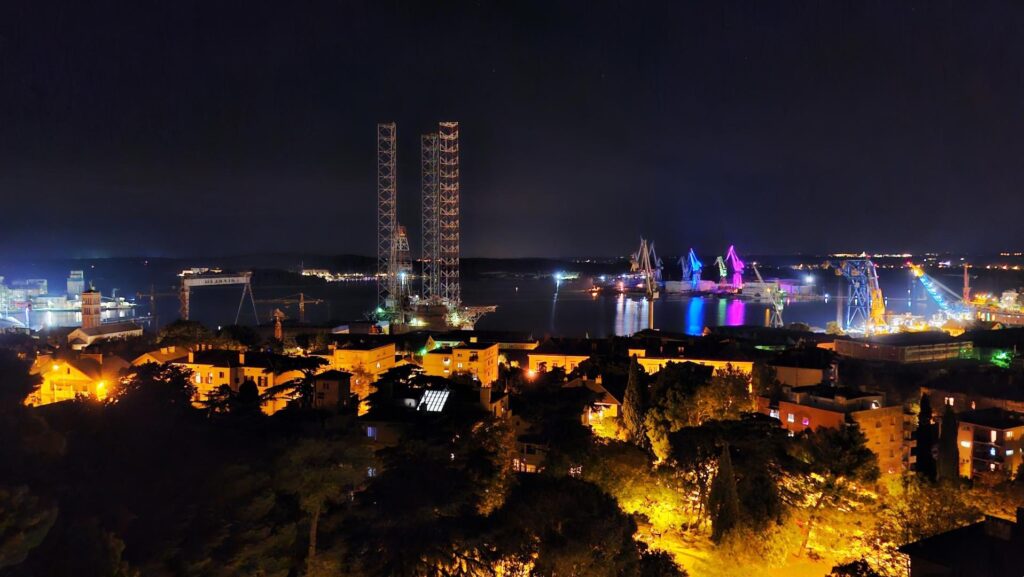
Stay near the shipyard after the tour for the Lighting Giants. Every evening from dusk, the Uljanik cranes light up in colour combinations designed by Dean Skira. The display runs through 16,000 different configurations and stays on until midnight in summer. Watching from the waterfront costs nothing. Few things in Pula after dark are more worth seeing. Plan your evening around this one.
Concert at the Arena
Every summer, Pula Arena hosts a concert season that is frankly absurd for a city this size. The venue is a Roman amphitheatre from the first century, still largely intact, and open to the sky. If a concert is on during your visit, go. The setlist matters less than you think. Watching live music inside a two thousand year old Roman amphitheatre is a bucket list moment regardless of who is on stage. Check the Arena programme here before you travel and book early. It sells out.
Pula Film Festival
Every July, the Arena becomes an open air cinema for the Pula Film Festival. This is Croatia’s oldest film festival. Croatian and international films play against the walls of the amphitheatre. Tickets are affordable and the atmosphere is relaxed. Even without a strong interest in film festivals, the setting alone makes this worth attending.
Cave Romane
Just outside Vinkuran, a few kilometres from the city centre, you will find the quarry where Romans cut the stone for the Arena. Two thousand years later, Cave Romane hosts some of the best open air concerts in the region. The acoustics surprise people. The setting is unlike anything else in Croatia. The Rocks and Stars festival brings serious acts here every summer. Watching a concert at the place where the Arena began has a symmetry that is hard to find anywhere else. Check the programme at caveromane.com before your visit and book ahead for the bigger names.
A drink on the Roman Forum
Cvajner occupies a former bank building on Pula’s Roman Forum. Two thousand year old stone surrounds it on three sides. The beer selection is strong and the terrace looks directly onto the Temple of Augustus. This is not a nightclub. Cvajner is the kind of place where you sit down and notice where you actually are. It works well as a stop before or after anything else on this list.
The Small Roman Theatre
Near the Twin Gate, the Small Roman Theatre gets far fewer visitors than the Arena. Entry is free. The theatre hosts summer concerts and outdoor screenings and was recently renovated. Even if nothing is on, finding it on an evening walk through the old town is worthwhile. Pula does not advertise this one enough. However, you can check the programme here.
A note on timing
June, early July, and September suit most of this list better than the peak of August. The Film Festival and Arena concerts bring large crowds and the old town feels it. With some flexibility on dates, the shoulder of summer offers the best version of Pula’s evenings: warm enough, busy enough, and still feeling like a real city.
Looking for more off the beaten track ideas? Here is our guide to unusual things to do in Pula.